
The first version of Drupal 8 was finally launched on November 19, 2015! Ahead of the official release of this popular content management system, we explored how it works and what is new in it. That way we keep an eye on the latest technology so we can guide our clients as well as possible through the options available on the market when they set up their site.
At the same time, it is important to note that Drupal has announced the end of support for version 6 on February 24, 2016. If that is what you use for your website, you should consider migrating to a more recent version. If it is on 7, do not panic! That version is more mature today than the very recent edition is. Its support should therefore continue until Drupal makes a ninth available.
So it can be worth considering Drupal 8 for a new site whose development would start soon, especially if the platform’s core features (broader than in previous versions) are satisfactory for it.
It is worth noting, though, that this new version still has to be tested more widely given how recently it came out. Many additional modules are also not yet fully available. On that front, version 7 has a broader base, for the moment at least. Let us look at a few points on which Drupal 8 stands out:
Responsive management interface
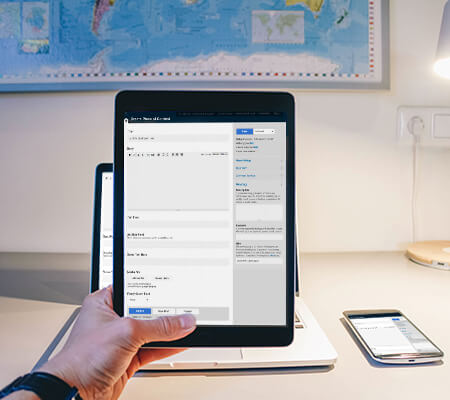
Drupal 8 ships with a responsive management interface. With the undeniable popularity of mobile devices, it will now be possible to manage your site or moderate it from a tablet or a phone, with ease.
Multilingual site support
Compared with version 7, Drupal 8 now ships with all the modules needed to create multilingual sites and interfaces. All you have to do is turn it on and configure it to suit your needs. Since even WordPress requires additional modules to support content in more than one language, this improvement is a competitive advantage. In our view it will lead to multilingual sites being built following recipes that are more uniform, better tested and better supported, both through community-developed modules and through Drupal updates.
Content fields ready to use
Content management systems, whether WordPress or even our in-house solution MM-CMS, come with a convenient WYSIWYG HTML editor by default, whereas Drupal 7 required installing an additional module to add and make available an editor such as CKEditor. In Drupal 8, that editor is available for adjusting page content with no programming or configuration needed, as soon as the initial installation is complete.
Along the same lines, a larger number of field types have been added to "Drupal core", so they are available as soon as Drupal is first installed with no additional modules, whether for entering email content, links, phone numbers, dates and so on. These structured data fields make it easy to create new content types (for example, pages representing products, employee contact pages, event pages and so on) in a simpler and more intuitive way, with no programming. So there is no need to program, or to install and maintain additional modules, to make it possible to enter and store this specific data.
A move towards the most modern programming standards adopted by the industry
Drupal has a reputation for being a platform centred on standards and conventions of its own, which made its learning curve harder for PHP programmers who wanted to extend its features.
Are you a PHP programmer, and are the words Symfony, Composer, PHPUnit or Twig familiar to you? Do you appreciate object-oriented programming, access to content through modern APIs and REST web services, and easier deployments between different environments as you move from development to pre-production and on to final launch? Then creating custom themes and modules for sites in Drupal 8 will seem much easier and more pleasant to you.
[clear]How will this affect our clients?
In the coming months, Drupal 8 will gain maturity and support through its community. While Drupal 7 should still be present and fully supported for the foreseeable future, we will be ready to take on the development of new sites with version 8 as soon as it has proven itself capable of meeting their needs.
When choosing a solution, it is important to be able to consider more than one platform and to select the one that best matches the needs. That is why we also offer site development on WordPress or on our in-house CMS, MMCM. Compared with WordPress, Drupal is a choice worth considering for sites with a larger and more varied volume of content, distinguished by more custom features.