

Is your new website finally responsive and adjusted for mobile devices? That is good, but it is not enough. You have to think mobile all the time. You need a strategy specific to mobile, a strategy thought through inside a complete mobile ecosystem, and another one inside a multi-device ecosystem.
Here are a few numbers that I hope will convince you of the need to act.
A "mobile only" shift has started everywhere on the planet
Everywhere on the planet, and not only in South Korea, time spent on mobile keeps eating into time spent on every other device (PCs, laptops, tablets, connected TVs). I am using the word "eating" on purpose, because you may well not see major growth on your statistical radar compared with last year. It varies enormously from one industry to another.
The graph below shows the 2014 growth in American consumer spending on mobile (the expression "m-commerce" used in the graph below covers tablets as well as smartphones).
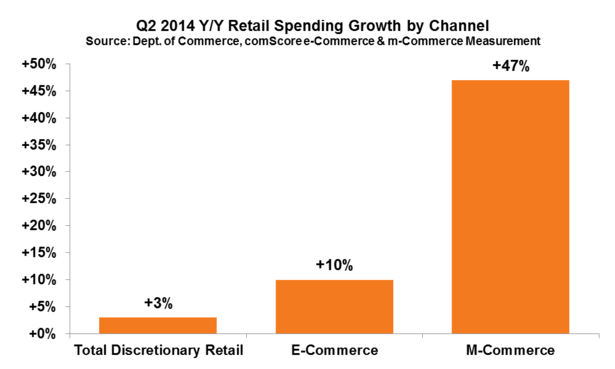
comScore found growth of 47% in a single year on that specific channel. Note as well that growth in electronic commerce ("e-commerce") in general is less dramatic, at 10%. That was a year ago.
In Germany, a survey in the spring of 2015 found that 64% of mobile device users (phone or tablet) have already made a purchase with their device .
In China, an analysis carried out in the spring of 2015 estimates that a third of online purchases made by consumers in 2013 were made on a mobile device .
More recently, in June 2015, and closer to home, a study of Canadian millennials, those aged between 18 and 29, showed that their PC use is in free fall. For the first time, the time this segment of the population spends online on a PC-type computer fell below 50%, to 46%, against tablet (15%) and mobile (37%) .
Multidimensional usage behaviour
Canadians do not only transact on mobile, of course. A Google study released in November 2013 found that "77% of users have already used their phone to search for a product or a service". That was more than a year and a half ago.
Other numbers from the same study (a survey of 1,000 Canadian adults online aged between 18 and 64) bring out the variety of uses Canadians make of their mobile device:
- Smartphones are used everywhere; 96% of users use theirs at home;
- 55% run searches every day (for restaurants, cafes, bars, travel, job offers, apartments);
- 46% have made a purchase from their phone in the past month;
- 85% access their email;
- An average of 12 applications were used over the past 30 days;
- 75% watch video;
- 78% check social networks;
- 89% of smartphone users have searched for local information,
- 88% took action following their search
- Searches started on a smartphone lead to purchases in various channels (32% then made a purchase on a computer, 37% did so in store);
Using applications, preferred over mobile websites
In India, the country’s largest electronic commerce company, Flipkart, is currently considering closing its website in order to concentrate its development effort on its mobile applications. You read that correctly. The co-founder states plainly that not having a "mobile only" strategy is the greatest risk any company faces, in any country in the world.
You think that is not happening here? A study by Paypal and Ipsos found in February 2015 that 55% of Canadian "mobile buyers" transacted using an application. Among mobile buyers who had transacted both on a mobile website and through an application, 46% preferred to do so on the application, against 14% on the mobile website .
So this is a change in consumer behaviour that took place in 2014 and 2015, a shift from the desktop computer to "mobile only", a growing comfort with using mobile to transact on the web without even going through the traditional PC.
Building a fully mobile strategy
Publishing Google Adwords ads on mobile, or advertising on Facebook in the hope of capturing the attention of some users for a few seconds, is not enough. You have to design your digital strategy on the basis that the entire pre-shopping, shopping and purchasing cycle will more and more be completed on a mobile device: from receiving an email to closing the purchase, by way of a campaign on Facebook, Instagram, Twitter and, why not, the exclusive sponsorship of an application. You also have to consider the different contexts those users may be in: at home, on the road, at work. Keep in mind that a person looks at their mobile phone on average 150 times over the course of a day and, once again, that the average number of applications a user has used over the past 30 days is 12.