
WHAT ARE WE TALKING ABOUT?
Consumer presence on social media is now beyond question in Quebec as elsewhere in the world, and rolling out an effective communication strategy on Facebook, Twitter and other social networks remains a sizeable challenge for organizations that want to keep a profitable dialogue going with their customers, partners and suppliers. Moving from one-way communication to a "conversational" mode, identifying the extra effort internal resources will have to put in or that will be subcontracted to suppliers, putting an effective governance policy in place, or measuring the results of the effort spent: all of these are real challenges for most organizations.
We believe that successfully bringing social media into a company’s communication strategy takes constant effort, a clear vision and a realistic approach. With social media you have to change the frame of reference, because the context and the tactics no longer match conventional interactive communication practice.
What we are dealing with here are media the organization does not "control". These are communities, so "conversations" and "two-way" exchanges where the organization exposes itself to its environment and its ecosystem. A good strategy for deploying and using social media has to start with a message, or let us call it "editorial content", that speaks to the audience and prompts it to react and interact. That content (and the conversations that follow from it) has to reach beyond the one-off nature of an event or a campaign and last over time through "enhancements", exchanges and stories to tell that "speak the same language" as the target audience.
To pull that off, you need tools, guidelines, simple processes and above all a mindset driven by a passion for exchanging with others and for exposing yourself authentically. We firmly believe that a successful social media deployment strategy goes far beyond simply creating "a physical presence" on the platforms available today and tomorrow. It has to be the combination of all of it.
A successful approach lets a genuine source of business intelligence emerge. That source can help you:
- Guide and support your communications and PR teams with a view to visibility and to crisis management.
- Deepen your understanding of your customers and your critics (in order to engage influence factors and improve your SEO/SEM).
- Identify your ambassadors (and potentially turn them into partners).
- Develop new initiatives (emerging trends).
- Strengthen your social responsibility and how it is perceived.
- Improve the service you offer.
- Identify 2.0 spaces where you can place advertising and push content.
- Strengthen your positioning (visibility and reputation) and understand that of your competitors and of the industry (openings and threats).
- Guide how your events and special projects unfold (the "virality" of the tactics and measurement of online impact).
MAPPING
In order to propose a relevant strategy, we believe the first step is above all to understand your organization’s context (missions and mandates), its needs and its expectations. Only once that step has been completed successfully can the scope of the work be handled effectively.
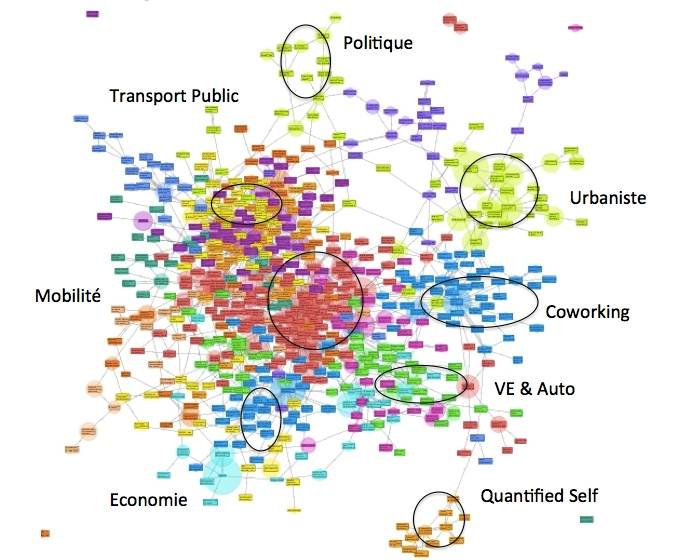
As a starting point, we strongly recommend beginning any exercise by drawing up a "map" that represents the organization’s social media ecosystem. That map will let you learn more about your target audience: communities of interest, platforms to target, spheres of influence tied to those platforms. It will also be very useful for recommending target audiences and setting realistic objectives.
TARGET AUDIENCES
As mentioned above, analyzing the ecosystem through the "map" should tell us:
- Where are these targets?
- Which social platforms are used?
- What kind of use is made of them?
- What kind of content is exchanged?
- Who are the potential influencers or ambassadors present on those platforms?
Each target has distinct characteristics in terms of visibility, interests and type of interaction:
- Some are more inclined to take part, others are rather reluctant.
- Some are active, consume information and share it, others are rather passive, are interested, consume information but do not share it.
- The institutional audience tends to look for and consume information tied to economic activity, for example, while the general public will be more interested in the social impact of the organization’s activity on its immediate environment.
- Finally, whatever the target, there will be profiles intrinsically tied to age, sex and regional proximity.
These target audiences have to be analyzed in detail, by defining typical profiles. Good practice is to identify the following attributes for each profile, in addition to the attributes deduced from the mapping analysis:
- Editorial content: what information we share;
- Editorial tone: how to phrase it and in what format;
- Communication frequency: do not flood them with communication, but above all avoid the "silence" phenomenon. So, find the right balance.
- Objective to reach: what is our end goal? What would the desired interaction cycle be?
Next: Social media for business: Guiding principles